
Minor Car Accident Report Roadmap: Get, Verify, Fix Police Report
You tap bumpers in slow traffic, nobody leaves in an ambulance, and everyone assumes it’s just “minor paperwork.” A few days later, your insurance adjuster, HR department, or lawyer asks for the police crash report, and that’s when the maze starts.
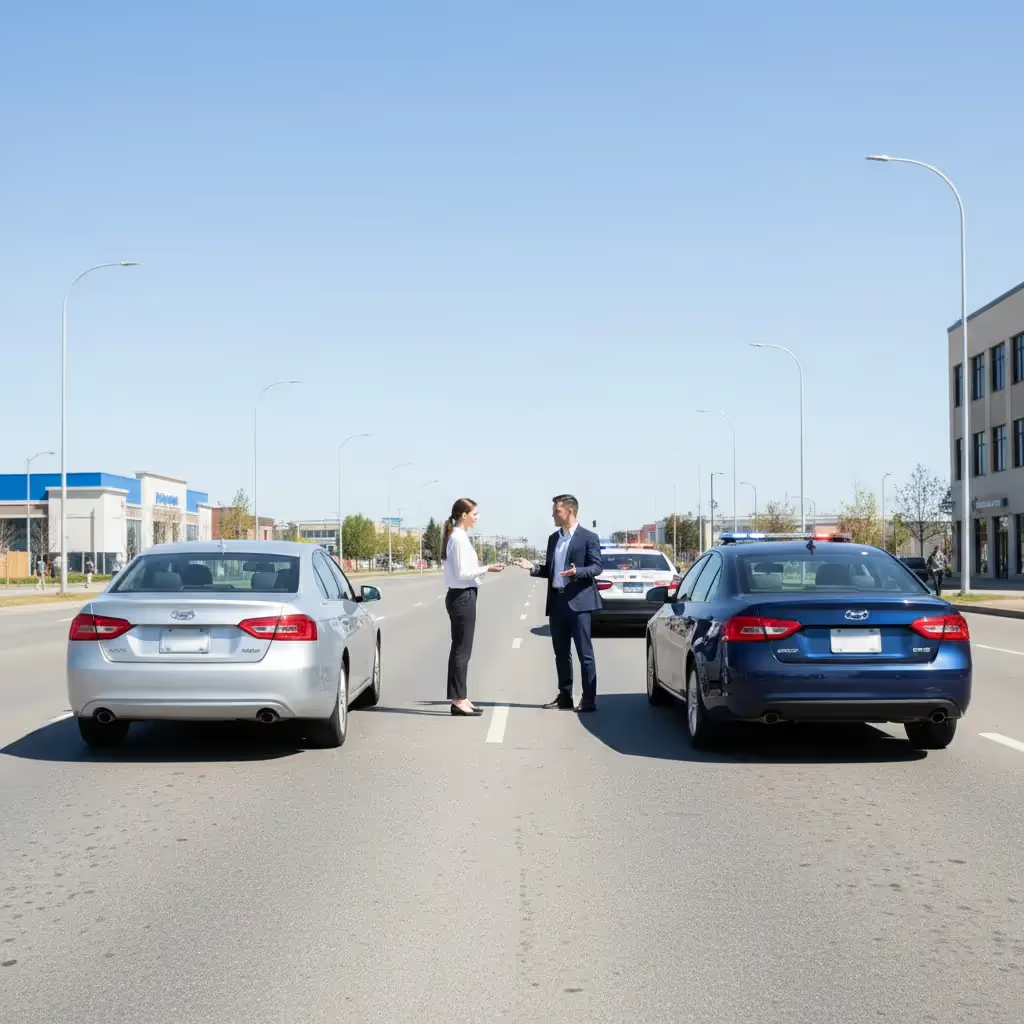
A minor fender‑bender can still create a surprising amount of paperwork once insurance and employers ask for the police report.
This guide walks through, in plain language, how to track down the right minor car accident report, confirm it’s the correct one, and request fixes when the officer’s notes don’t match what actually happened. We’ll cover multi‑state confusion, missing case numbers, and how to handle factual errors without turning your week into a full‑time records project.
Even small fender‑benders can stall an insurance claim if you have the wrong report — or no report at all.
TL;DR: The 4-step roadmap
- Confirm the agency: City police, county sheriff, or state highway patrol, based on where the officer came from and where the crash happened.
- Request the report: Use the agency’s records unit or online portal with names, date, location, and VIN — even if you don’t have a case number.
- Verify details: Check names, spelling, dates, location, VIN, and the diagram before you share it with insurance or your employer.
- Fix issues: Ask for factual corrections or add a written statement when you disagree with opinions in the narrative.
If you’d rather not handle this alone, you can use Accident Report Help and let our team track down the correct agency and monitor the request for you.
Why a “minor” car crash report still matters
Insurance companies, employers, and lawyers care less about whether the crash felt small and more about whether there is an official record. A missing or sloppy police crash report can delay claims, raise questions about fault, or cause problems with workers’ comp or company vehicle policies.
Many drivers only discover this when someone suddenly asks for a certified copy or threatens to close a claim without it. That’s why getting the right report early — and making sure it’s accurate — saves time and stress down the road.
For a deeper look at what accident reports typically include, you can also read our intro to police accident report fields.
Step 1: Figure out which agency has your report
This is where many people get stuck. Was it city police? The county sheriff? State highway patrol? Out on the interstate or near a state line, it’s easy to guess wrong and keep calling the wrong records office.

Start by using what you remember from the scene and online agency resources to pinpoint who actually holds your crash report.
Start with what you remember from the scene
- Look at the officer’s uniform or vehicle: City name on the door usually means city police; “Sheriff” points to the county; “Highway Patrol” or “State Police” signals a state agency.
- Check any paperwork handed to you: An exchange of information form or business card often lists the agency and badge number.
- Ask your insurance adjuster: Adjusters sometimes note the reporting agency and incident number in their internal file.
Use the crash location to break ties
When you aren’t sure who responded, use the exact location:
- Inside city limits: Usually city police, sometimes sheriff’s office for small towns.
- Rural highways and county roads: Often the county sheriff or state police.
- Interstates: Commonly state highway patrol or state police.
Many agencies publish their report request rules on their own websites or through state portals. Official resources like the National Highway Traffic Safety Administration (NHTSA) can help you confirm basic terms and reporting practices.
What if the accident was in another state?
Out‑of‑state crashes add an extra twist: you’re dealing with unfamiliar agencies and different public‑records laws. A few tips:
- Search for “[State] police accident report” or “[City] police crash report request” and confirm you’re on an official .gov or .us site.
- Check whether that state uses a central crash portal or leaves everything with local departments.
- Remember that federal FOIA rules don’t automatically apply to state and local police; each state has its own open‑records law.
If this step feels like too much back‑and‑forth, services like Accident Report Help’s request process specialize in figuring out which office actually holds your report and handling the request on your behalf.
Step 2: Request the report (with or without a case number)
Once you know the right agency, you have to get into their system. Every department does this a little differently, but they almost always want the same core details.
Information you should gather first
- Full legal names of drivers and, if possible, passengers
- Date and approximate time of the crash
- City, county, and nearest intersection or highway mile marker
- Vehicle details: make, model, and VIN if you have it
- Case, incident, or report number (if one was given)
How to get a report when you have the case number
With a case number, the process is usually straightforward:
- Go to the agency’s records page or online crash portal.
- Enter the case number and basic filters (date, last name, etc.).
- Pay any standard fee for the report or certified copy.
- Download the PDF or confirm how it will be delivered (email, mail, pickup).
How to get a report when you don’t have the case number
This is common, especially after a fender‑bender where everyone wanted to get home fast. In that situation:
- Use an online request form that searches by name, date, and location instead of case number.
- If no online option exists, call the records unit and provide those details by phone or email.
- Be ready to confirm your role in the crash (driver, passenger, owner) because access rules can differ.
Many states publish general guidance on police and crash records through their main portals or attorney general websites; checking those first can clarify who may request what, and when.
If you’d rather have someone else keep track of case numbers and release dates, you can submit a request through our Find My Report page and let our team follow up with the agency for you.
Step 3: Check that you have the right crash report
Before you forward the PDF to your insurer or employer, take a slow pass through the details. Small mistakes today can snowball into big questions later.
Key items to confirm
- Names and contact information: Correct spelling, addresses, and phone numbers.
- Vehicle information: Make, model, year, license plates, and VINs.
- Date, time, and location: Match your memory and any photos, dashcam videos, or texts you sent right after the crash.
- Insurance information: Policy numbers and carriers for each vehicle.
- Diagram and narrative: The drawing and written description should generally reflect how the crash unfolded.

Take a careful pass through your minor car accident report so factual errors don’t create problems later on.
Keep a copy of the report stored safely. Many people also share a copy with a trusted mechanic, doctor, or attorney if there are ongoing vehicle or injury questions.
Step 4: Fix errors or add your side of the story
Not every mistake is treated the same way. Agencies usually separate factual errors (like a wrong VIN) from disputes about judgment (like who was at fault).
Factual errors agencies may correct
These are usually the easiest to fix:
- Wrong spelling of a name
- Mistyped license plate or VIN
- Incorrect insurance company or policy number
- Clearly wrong date, time, or location
Every department has its own system, but the basic steps often look like this:
- Contact the records unit listed on the report.
- Explain the specific factual error and provide proof (driver’s license, registration, insurance card, etc.).
- Ask whether they issue an amended report, a supplemental report, or a note in the file.
- Request a fresh copy once the change is processed.
When you disagree with the officer’s opinion
Officers are usually less willing to rewrite their opinions about fault, weather conditions, or driver behavior. In many states, though, you can ask that a written statement be attached to the report so your perspective is preserved in the record.
That statement might include:
- Your description of what happened, in order
- Any details you feel were overlooked (traffic lights, lane markings, road hazards)
- References to photos, dashcam footage, or witnesses you shared with the officer or insurer
If you are working with a personal‑injury lawyer, ask how they want you to handle this step. For general background on how reports fit into legal questions, our partner firm shares educational material on Cirrus Law Group’s website.
Keep in mind that nothing here is individual legal advice. Local rules can differ, and an attorney in your state is the best source for guidance on disputed reports.
Common problems & when to get extra help
Even when you follow every step, a few issues show up again and again:
- The report isn’t ready yet: Some agencies take days or weeks to approve and release crash reports, especially if photos or diagrams need review.
- The portal can’t find your report: A typo in the spelling of your name or the date range can hide your record.
- Access is restricted: Cases that involve minors, ongoing criminal investigations, or sensitive details may have extra rules.
- You’re passed between agencies: City police say it’s with the sheriff, the sheriff says it’s with state patrol, and everyone is sure it’s “not here.”

When the back‑and‑forth becomes too much, a report retrieval service can handle locating and requesting your minor car accident report for you.
At that point, many people decide their time is better spent on work, family, and recovery than on chasing paper. That’s where a retrieval service such as Accident Report Help can step in: we identify the right agency, submit the request, track status, and email the PDF once it’s released, with a nationwide coverage map across all 50 states.
For more background on public‑records rules and timelines, federal resources like USA.gov’s open government page offer helpful, high‑level explanations.
Quick FAQs about minor accident police reports
How long does it usually take for a minor crash report to be ready?
It can range from a couple of days to a few weeks, depending on the agency, staffing, and whether photos or supplemental notes need approval. If your insurer is pressing for an update, ask the records unit for an estimated release window.
Can I get a police crash report if I was only a passenger?
Often yes, but rules differ by state. Many agencies treat involved passengers the same as drivers for access purposes, while others limit copies to vehicle owners or listed drivers. Check the specific agency’s policy or your state’s public‑records information page.
Do I really need a police report for a minor fender‑bender?
Not every minor crash legally requires one, but a report can help with contested fault, hidden injuries, or later vehicle problems. Some employers and fleet managers also require a copy any time a company vehicle is involved, no matter how small the damage looks.
Will fixing a typo change who was found at fault?
Correcting factual details rarely changes the officer’s opinion about fault by itself. That said, accurate facts give insurers, employers, and courts a better foundation if they need to review what happened.
Is using a report retrieval service legal?
Yes. Services like Accident Report Help simply handle the legwork: identifying the right agency, submitting the request with your authorization, paying official fees, and delivering the report securely. You still have the same rights to the report; you’re just not the one standing in line or refreshing portals.
Key takeaways & next steps
- Even “minor” accidents can stall claims if the wrong police crash report is requested — or none at all.
- The three big jobs are: find the right agency, request the report with solid details, and double‑check accuracy.
- Factual errors can often be corrected; disagreements about judgment may need a supplemental statement or legal advice.
- If the back‑and‑forth with multiple departments is wearing you out, you can hand the process off.
When you’re ready to move this off your plate, start a request through our Find My Report page. Give us the basics (names, date, city, and any case number you have), and our team will work on locating and requesting the correct report for you.