
How to Read a Police Accident Report Online From Any State

Your neck still aches, your car is somewhere at a tow yard, and the insurance adjuster has already emailed twice asking for “the police report.” You know it exists. An officer took notes, maybe snapped a few photos, and handed you a card with a case number that you’ve now misplaced.
Now you’re trying to read accident report details online, but every government site looks different, you’re not even sure which agency wrote it, and you might be in a different state than where the crash happened. This guide walks you through the process, step by step, so you can stop guessing and get clarity.
TL;DR:
- Figure out which police agency likely wrote your report (city police, county sheriff, state police, or highway patrol).
- Check whether the report is ready to be released (many agencies take 3–10 days after the crash).
- You can click through multiple different government portals yourself, or use a nationwide report-finder service that does the lookup and request for you.
- Once released, your report is usually delivered as a PDF you can read on any device, share with insurance, or save for your records.
Why reading your accident report online feels so hard
Most people expect this to work like tracking a package: type in a number, press a button, boom — there it is. Car crashes do not work like that.
Here’s what trips people up right after a collision:
- Too many agencies. City police, county sheriff, state police, highway patrol, turnpike or tollway police — any of them might have responded.
- Every state does it differently. Some states run crash reports through the state police, others through a Department of Transportation or DMV, others leave it to each local department.
- Government portals feel clunky. Forms time out, wording is confusing, and you often need a case number, incident number, or “NCIC” number you no longer have.
- You might be out of state. Maybe you live in Ohio, but the crash happened on a Georgia interstate during a road trip. Now you’re juggling two sets of agencies and websites.
“I kept bouncing between three different police websites. Each one said, ‘If your crash was handled by another agency, contact them.’ I had no clue who ‘them’ was.”
If that sounds familiar, let’s break this into three simple steps so you can stop clicking in circles and actually read the document everyone keeps asking for.
Step 1: Figure out which police agency has your crash report
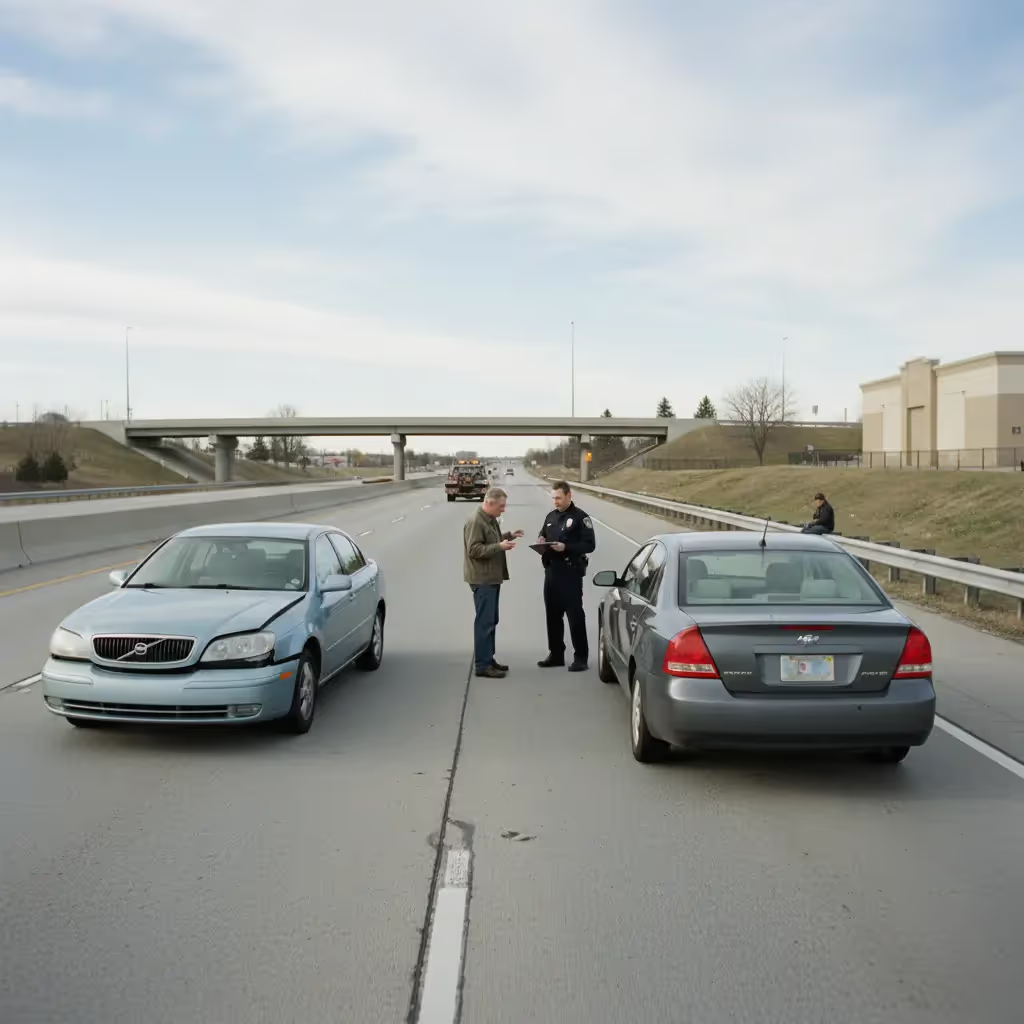
The hardest part for most people is the first question: who actually wrote the report?
Start with what you remember from the scene
Think back to the officer who responded. A few clues can narrow this down fast:
- Uniform and vehicle markings. Did you see “Police,” “Sheriff,” “Highway Patrol,” or “State Trooper” on the car or jacket?
- Road type. Crashes on local streets are usually handled by city or town police. Crashes on interstates, toll roads, or state highways are often handled by state police or highway patrol.
- Where it happened. Inside city limits? Near a county line? In a rural area with no city nearby? That can switch the responsible agency.
- Paperwork you received. Any ticket, information card, or exchange-of-information sheet may list the department name, badge number, or case number.
If you still have the officer’s card, look for wording like “City of Phoenix Police Department” or “X County Sheriff’s Office”. That’s usually your report holder.
Use a quick “agency checklist”
When you’re not sure, this simple checklist helps narrow things down:
- Inside city/town streets: Likely the city police department.
- Rural two-lane road: Could be the county sheriff or state police.
- Interstate or state highway: Often the state police or highway patrol.
- Parking lot or private property: Sometimes the local police; in some places, they document but do not file a formal state crash report.
If this still feels like guesswork, you can hand that detective work to a service like Accident Report Help, which pinpoints the right agency based on your crash details and state rules.
Step 2: Confirm your report is ready to read online
Even once you know the right agency, the report might not be ready yet. Here’s what usually has to happen first:
- The officer finishes the original crash report back at the station.
- It goes through internal review or approval.
- The report is uploaded to a state system or local records portal.
Many agencies say reports are available in about 3–10 business days, though serious crashes can take longer.
How to check status without making five phone calls
Depending on the state and agency, you might be able to:
- Search a public crash report portal by last name and crash date.
- Call a records division and ask, “Has the report for my crash on [date] been released yet?”
- Use a report request helper that keeps checking until the agency posts it.
If the officer mentioned a “supplemental” or “amended” report, that can add extra days while additional statements, diagrams, or corrections are completed.
Step 3: The fastest way to read your accident report from any state
Once the report is released, you have two main options to read it online:
Option A: Work through government portals yourself
This path is fully do‑it‑yourself:
- Find the official site for the agency you identified in Step 1 (city police, county sheriff, or state police).
- Look for sections labeled “Public Records,” “Crash Reports,” “Accident Reports,” or “Records Request.”
- Complete the online form or PDF. You may need:
- Full name and date of birth
- Crash date and approximate time
- Location (intersection, highway, or mile marker)
- Case number or incident number (if you have it)
- Pay the report fee, usually in the $5–$25 range, using a card or e‑check.
- Wait for an email link or log back into the portal to download the PDF.
Plenty of people go this route and get what they need. For others, the friction comes from trying three wrong portals, getting error messages, or not having the exact number the system wants.
Option B: Use AccidentReportHelp.com to locate and request the report for you
If you don’t have the time or energy to deal with several different sites, AccidentReportHelp does the legwork:
- You complete one short online form with your crash details, from any of the 50 states.
- Our team identifies the correct city, county, or state agency, based on where and how the crash happened.
- We submit the request using that agency’s preferred process and track it until release.
- When the report is released, you receive a secure PDF by email, usually within 24–72 hours of the agency posting it.
You pay the same official agency fee that you would pay on your own, passed through transparently, and we back the process with a money‑back policy if the report cannot be released.
No guessing which portal to use. No hunting for logins in your inbox. Just the document you need, ready to read on your phone, tablet, or computer.
How long does it usually take to read an accident report?
Every case is different, but here’s a rough timeline many people see:
Some departments spell out their timing on official sites. For instance, the Florida Department of Highway Safety and Motor Vehicles notes that traffic crash reports may take up to 10 days to become available, and the New York State DMV explains that crash reports can take 14–60 days to appear in its system before you can purchase them online. The Insurance Information Institute also shares helpful post‑crash timelines.
If your crash was serious (injuries, commercial trucks, multiple vehicles), the investigation can extend that window. That doesn’t mean anything is wrong — it often just reflects extra documentation.
Can you read someone else’s accident report?
This is one of the most common questions people ask: “My friend was in a crash — can I pull their report?” The answer depends on state law and your role.
People who usually can request and read a crash report
- Drivers and passengers who were in the vehicle
- Vehicle owners (including parents of teen drivers)
- Next of kin in fatal crashes
- Insurance companies and adjusters handling a claim
- Attorneys or authorized representatives with permission
Some states also allow limited public access after a waiting period, while others restrict reports more tightly to protect privacy. When Accident Report Help handles a request, we follow each agency’s eligibility rules and will let you know if more documentation or proof of relationship is required.
What to look for once you have the report
Reading your report for the first time can feel strange. It’s your crash, told in official language by someone who met you on one of your worst days.
Key sections to read closely
- Names and contact details. Are your name, address, and insurance information correct?
- Date, time, and location. Does the report list the right intersection, direction of travel, and lane information?
- Diagram and narrative. How does the officer describe what happened? Do the arrows and notes match your memory?
- Citations or contributing factors. Look for boxes that mention “driver inattention,” “following too closely,” or similar codes.
- Injuries and vehicle damage. Check how injuries are coded and which parts of the vehicle are marked as damaged.
If something looks off, take a breath. Reports can contain mistakes, especially with spelling or minor details. Many departments have a process for requesting corrections or adding a supplemental statement.
Important: This article is for general information only and is not legal, medical, or insurance advice. If you have questions about fault, lawsuits, or medical bills, speak with a qualified professional in your state.
Crash reports are one piece of a bigger puzzle. For broader safety context, national resources such as the National Highway Traffic Safety Administration share research on collision patterns, seatbelt use, and more.
Ready now? Read your accident report with AccidentReportHelp.com
If you’re out of state, juggling work and medical appointments, or just tired of trying three different police portals, you don’t have to do this the hard way.

Here’s what happens when you click “Find My Report”:
- Share your crash details once. Tell us where and when the crash happened, who was involved, and anything you remember about the responding officer.
- We locate the right agency. City police, county sheriff, state police, or highway patrol — we track it down across any of the 50 states.
- We submit and track the request. Our team handles the paperwork, follows that agency’s process, and keeps an eye on status.
- You receive a secure PDF. As soon as the agency releases the report, we deliver it to your inbox as a password‑protected file you can read, print, or share.
If you want to understand more about how we handle data and privacy before you submit anything, you can read our Privacy Policy.
Quick recap
- You don’t need to be in the same state as your crash to read your police report online.
- The hardest part is usually figuring out which agency wrote the report; use the scene details to narrow it down.
- Reports often take a week or more before they’re ready in online systems.
- You can work through government sites yourself or let a nationwide report‑finder service handle the puzzle.