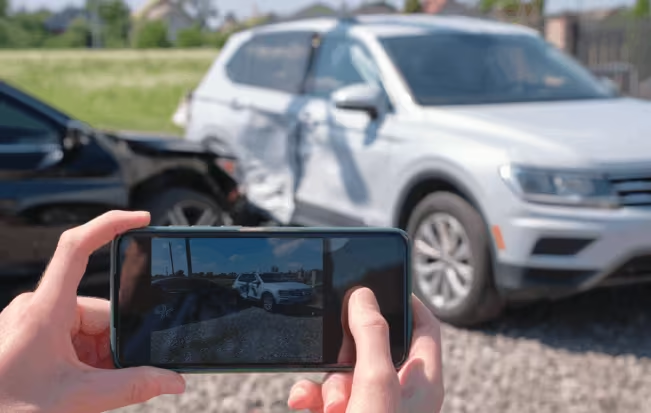
How to Get a Copy of a Police Report After a Car Accident: Even If You’re Out of State and Don’t Know Which Agency Has It

If you were just in a wreck and now you’re trying to figure out how to get a copy of a police report, the last thing you need is a wild goose chase from one phone number to the next. Maybe the crash happened on a highway outside town or in another state, and now no one can tell you whether city police, the county sheriff, or the state patrol handled it.
Meanwhile, your insurance company keeps asking for a report or case number, online portals assume you already know the right agency, and you definitely can’t stroll into a station across the country during business hours. This guide walks through clear, real‑world steps to figure out who has your report and how to request it from home, plus what to do if you would rather have a service like AccidentReportHelp.com handle the legwork.
TL;DR: Fast path to your accident report
Short on time? Here’s the quick version:
- Gather basics: date, time, city/county, road or intersection, vehicle plates, and names.
- Figure out the likely agency (city police, county sheriff, or state police/highway patrol, depending on where the crash happened).
- Call non‑emergency/dispatch with your details and ask which agency wrote the crash report.
- Once you know the agency, check its website for “accident report” or “crash report” request instructions.
- If you’re stuck or out of state, you can use AccidentReportHelp.com’s online form and let a team track it down for you.
First steps when you don’t know who has your report
Picture this: you’re rear‑ended in a rental car while passing through another state. Days later, your insurer wants the official report, but every agency you call shrugs and sends you somewhere else.

When that happens, start simple:
- Check any paperwork from the scene. A card, print‑out, or photo from the officer can hold clues about the agency or case number.
- Look up the exact crash location on a map. Note the nearest city or town, county, mile marker, or exit number.
- Call the local non‑emergency number (not 911). Ask, “Which department handles crashes at [location]?”
- Ask dispatch to search their log by date, time window, and your last name or license plate.
If no one can figure it out after a couple of calls, that’s a good moment to either broaden the search (city, county, state patrol) or let a dedicated accident report service handle it for you.
Step 1: Gather the crash details you’ll be asked for
Records units usually ask the same starter questions. Having answers ready saves time, especially if you’re calling from another state.
Information that helps locate your report fast
- Crash date and approximate time (or at least a 2–3 day window).
- City or town, county, and exact location (road name, highway number, mile marker, or nearest intersection).
- Your full name (and date of birth if requested).
- Vehicle details and license plate numbers for the vehicles involved.
- Names of other drivers, if you have them.
- Any case, incident, or report number on a card or ticket, plus any officer name or agency shown.
You rarely need every single detail on this list. But the more you can share, the easier it is for a clerk or dispatcher to search the system and confirm which department wrote the report.
Step 2: Figure out which agency likely handled your accident
Once you know where the crash happened, you can usually narrow things down to one of three options.
- Inside city limits: usually the city or town police department. Check its website for a “Records” or “Crash Reports” page with request instructions.
- Outside city limits but not on an interstate: often the county sheriff, especially on rural roads and county highways.
- Interstates and major state highways: typically state police or highway patrol, sometimes through a state crash‑report portal. For a quick starting point, you can check your state on the National Highway Traffic Safety Administration site, then follow links to state enforcement or crash data portals. For example, Texas drivers can use the state’s Crash Report Online Purchase System to order crash reports.
Sometimes more than one agency shows up—for example, local police may direct traffic while highway patrol writes the report. Ask dispatch which agency is listed as “primary,” whether another department actually wrote the report, and keep notes on who you spoke with and when. When you use a retrieval service like AccidentReportHelp.com, this kind of multi‑agency legwork is handled for you in the background.
Step 3: Ways to request your police report
Once you know which department holds your crash report, the rest is choosing how to request it: online, by mail, or in person.
Common request methods
- Online portal: Search by name, date, or report number and pay by card. This is often the fastest option when your agency offers it.
- Mail or email form: Send a written request with payment. It works even for small departments with no portal but can take days or weeks.
- In person: Visit the records counter at the station. It’s helpful for questions but harder if you live in another state.

Typical fees and timing
Most agencies charge a small fee (often around $5–$25), and routine reports are usually ready in about 3–10 business days; serious or fatal crashes can take longer because of investigations and extra review.
If someone needs the report urgently, share any reference or receipt numbers from your request so they know it is in progress.
Step 4: Getting your report when you’re out of state
Being in a different state from the agency holding your report is common. Thankfully, most departments now allow some form of remote request.
Options when you can’t visit the station
- Use the agency’s online or mail‑in process. Many state patrols and larger cities let you request and download crash reports from anywhere.
- Give written permission to a trusted person nearby. A friend, family member, or law office can sometimes pick it up for you.
- Use a retrieval service. With AccidentReportHelp.com, you submit a short online form and the team works with the correct agency on your behalf, then provides your copy of the official report once it’s available, according to the service’s current delivery process.
Some cities also have local guides, such as our Austin police report guide and Miami accident report help, that walk through city‑specific options.
Each state has its own rules about who can request a report and how it can be delivered. When in doubt, read the agency’s instructions closely or talk to a staff member before sending payment.
This article shares general information, not legal advice. For specific legal questions, talk with a licensed attorney in the state where your crash happened.
FAQ: How to obtain a police report for insurance and more
How to obtain police report copies for an insurance claim?
For insurance, companies usually need the official crash report (not just the exchange information sheet). To keep things moving:
- Ask your claim representative which details they need: report number, agency name, or a full copy.
- Request the report from the right agency using the steps above.
- Upload it to your insurer’s portal or email it to your adjuster.
How can I obtain a police report if I never got a case number?
You can usually obtain a police report without a case number. Dispatch or records staff can search by:
- Your name and date of birth.
- Date and approximate time of the crash.
- Crash location (street name, highway, exit, or mile marker).
- License plate or VIN, if you have it handy.
If one agency can’t find it, ask whether another local agency or state patrol might have responded instead, then call that office next.
How do you obtain a police report when no one was ticketed?
Even if no one was ticketed, there may still be a report. Call the likely agency and say you were involved in a traffic accident at a specific time and place and want to know whether a crash report was filed and how to request a copy.
If no report exists, ask your insurer what other documentation they will accept, such as photos and written statements.
How long does it take for a police report to be ready?
For many routine fender‑benders, reports are ready within about a week, though serious‑injury or fatal crashes can take longer because of extra review.
If a week or two has passed and staff still can’t find your report, ask whether it is still pending, was sent to another division, or requires a written public‑records request under your state’s law.
For a plain‑language overview of collision reporting and statistics, the Insurance Information Institute has a helpful guide on auto accident police reports, and FindLaw’s explainer on obtaining and using a police report covers how reports are used in injury claims.
When a report may be delayed or restricted
Not every report is instantly available to everyone. Depending on your state’s public‑records laws, access can be limited for:
- Crashes involving fatalities or very serious injuries.
- Ongoing criminal investigations (for example, suspected DUI cases).
- Juveniles or sealed records.
- Requests from people who were not involved and have no legal interest.
Even in those situations, people directly involved in the crash (or their representatives) often still have a path to request a copy, though it might take longer or arrive with some details blacked out for privacy.
How Accident Report Help tracks down the right agency for you
If all of this sounds overwhelming and you’d rather have someone request the report for you, AccidentReportHelp.com can help. Here’s how the process usually works:

- You submit a short online form with your crash details—no need to know the agency or report number.
- The team identifies the correct department (city, county, or state patrol) based on your location, date, and other clues.
- They place the request with that agency and track it until the report is released.
- You receive your copy of the official report once it’s available, according to the service’s current delivery process.
AccidentReportHelp.com assists drivers nationwide in requesting official accident reports from the appropriate law‑enforcement agency. For current fees and terms, refer to the information on the service’s request form.
If you’re ready to hand this task off, you can start here: Find My Report.
Key takeaways
- You can start your search with solid details about time, place, and vehicles—even without a report or case number.
- City police, county sheriffs, and state patrols each cover different roads, so identifying who likely responded is the crucial first step.
- Online portals, mail‑in forms, in‑person visits, and retrieval services are all options; choose the one that fits your location, schedule, and comfort level.
Learning how to get a copy of a police report doesn’t have to take over your week. With the right details, a few focused calls, or a quick online request through AccidentReportHelp.com, you can get the documentation you need and get back to focusing on recovery.