
Car Accident Statistics & Police Reports: Find Your Crash Record Fast
Disclaimer: This article is for general information only and is not legal, insurance, or medical advice.

When you search for car accident statistics right after a crash, you are usually not looking for trivia.
Most charts talk about national death rates, while you are stuck with practical questions: Which agency has my report? How many days will it take? What if the crash was in another state and I am already back home?
This guide uses real crash data and agency timelines to show how long reports normally take, how to guess which department has your record, and concrete ways to get a copy so your claim can move forward.
TL;DR: The short version
- National car accident statistics explain why states push officers to file crash reports within a set number of days.
- For many routine crashes, police reports post in about 3–10 business days, though serious cases can take longer (see this North Carolina timeline).
- Reports are usually sent to a state crash database or records unit, not straight to your insurer—you or your representative must get a copy (see this Florida explanation).
- If the crash was out of state, the report sits with that state’s police, sheriff, or highway patrol system.
- A retrieval service like AccidentReportHelp.com can track down the right agency and deliver a PDF copy for you.
Why car accident statistics matter for your police report
Every crash report you and your insurer care about is also a data point in a national system. States feed your officer’s paperwork into the Fatality Analysis Reporting System and related FARS databases, which track where, how, and why crashes happen.
To keep those statistics consistent, states require officers to submit standardized crash reports within specific timeframes. Those same rules decide when your report exists in the system and why insurers treat it as core evidence.
“Your crash report is both a story of what happened to you and a line on a spreadsheet that drives state safety decisions.”
Quick context: key U.S. car accident statistics
Here is the recent scale of U.S. crashes, based on federal NHTSA estimates and the 2023 Traffic Facts 2023 summary (also available as an overview PDF).

- Crashes per year
- In 2022, 42,721 people were killed in motor vehicle crashes, a fatality rate of 1.34 deaths per 100 million vehicle miles traveled (VMT).
- In 2023, deaths fell to 40,901 and the fatality rate dropped to 1.26 per 100 million VMT.
- Early 2024 estimates project about 39,345 deaths and a rate of roughly 1.20 per 100 million VMT—the lowest since 2019 but still above the pre‑pandemic average.
- In 2023 there were about 6.14 million police‑reported crashes: roughly 37,654 fatal crashes, 1.70 million injury crashes, and 4.40 million property‑damage‑only crashes.
- Common risk factors
- Speeding: about 11,775 people died in speeding‑related crashes in 2023, roughly 29% of all traffic fatalities.
- Alcohol impairment: alcohol‑impaired‑driving crashes killed about 12,429 people in 2023, again about 29% of all traffic deaths.
- Distraction and seat belts: in 2022, crashes involving distracted drivers killed 3,308 people and injured an estimated 289,310 more, and in 2023 about 49% of passenger‑vehicle occupants killed were unrestrained, according to NHTSA’s distracted driving and restraint‑use research notes.
Those millions of mostly non‑fatal crashes translate into heavy paperwork for police and state records units—thousands of reports a week in some systems—which is why “3–10 business day” posting windows sometimes stretch longer in busy jurisdictions.
How those numbers shape police report deadlines
To keep crash statistics current, states set rules for how quickly officers must submit official reports. For example, one Georgia source notes that officers are required to file a report with the Department of Transportation within a few business days so the crash can be counted in state data and used by insurers (see this Georgia reporting rule).
The pattern is similar elsewhere: the officer investigates, completes a standardized form, and sends it to a central system (often the DOT or DMV). For you, it means there is usually a built‑in window—often within the first one to two weeks after the crash—when your report should exist in the government’s system.
If you hit the far end of that window with no luck, that is when many people start checking portals, calling records units, or using a retrieval service.
How long police crash reports usually take
Timelines vary by state and by how serious the crash was, but a few real‑world examples show a pattern:
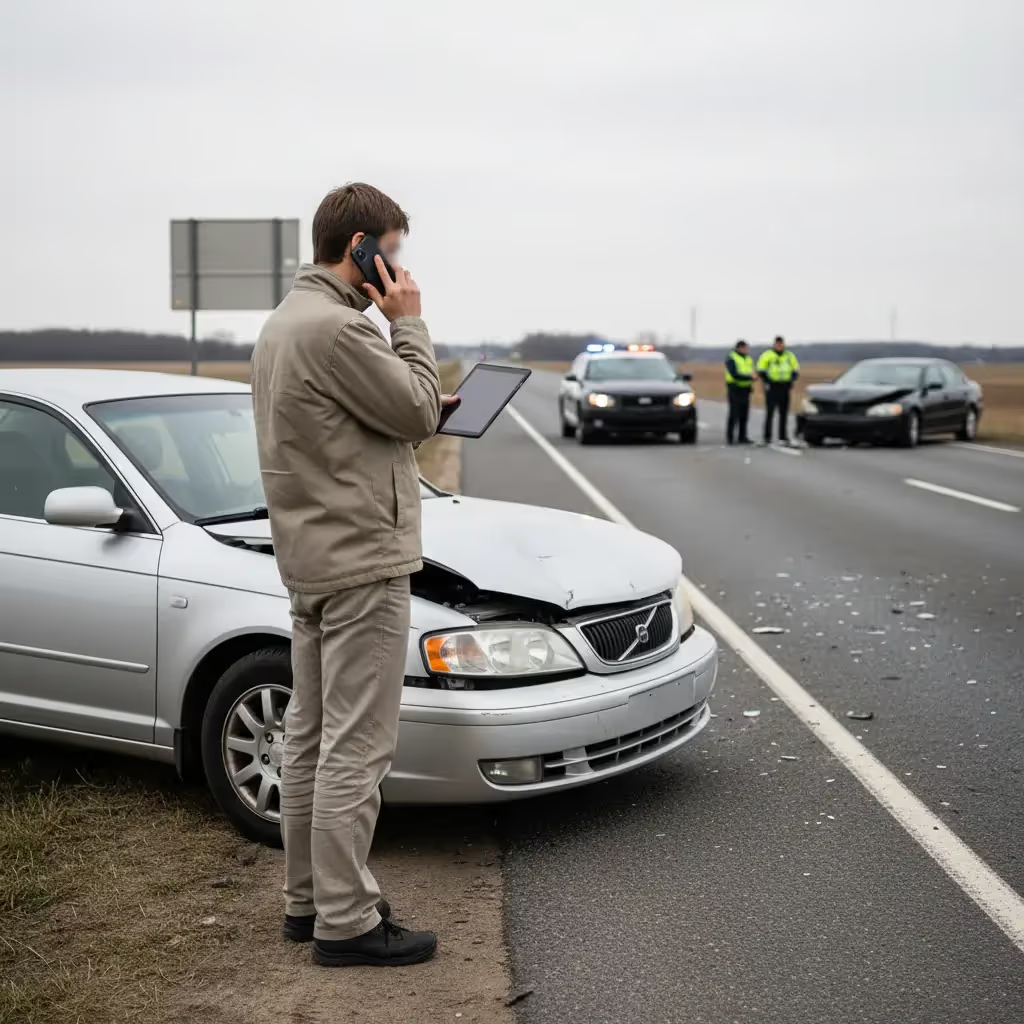
- North Carolina: many police crash reports post in about 3–5 business days, though serious crashes can stretch that to 7–10 business days or longer (see this North Carolina guide).
- Massachusetts: reports commonly become available from the Registry of Motor Vehicles within about 5–10 business days after the crash (see this Massachusetts overview).
- Texas: statewide systems often show reports around 7–14 days after the accident (see this Texas example).
- Florida: agencies typically must submit reports to the state within 10 days, and that is when many reports show up in the state portal (see this Florida timeline).
Put together, that means a common window for routine crashes is roughly 3–10 business days. If your crash involved serious injuries, a fatality, a hit‑and‑run, or many vehicles, it can take longer because the officer may add supplements and reconstructions.
Quick example: After a rear‑end crash in North Carolina, Jordan checked the state system after three days and saw nothing. By day seven the report appeared online and was sent straight to the adjuster, which finally moved the claim review forward.
If you are bumping up against two weeks with no sign of the report, that is when many people start calling records units—or hand the search to a service like AccidentReportHelp.com to track it down. You can also watch for updated state patterns in our state timelines.
Step‑by‑step: the “Where–Who–When” checklist to find which agency has your report
Before you can order a copy, you have to know which department wrote it. Here is a simple process that uses what we know from car accident statistics and state reporting rules.
The “Where–Who–When” checklist
Think of the search in three quick passes: where the crash happened, who wrote the report, and when it is likely to post.
1. Where: where you were driving
- Inside city limits on local streets? Likely a city police department.
- On a county road, rural intersection, or outside city limits? Often a county sheriff’s office or state patrol.
- On an interstate or U.S. highway? Frequently the state highway patrol or state police.
If you still have the exchange form the officer handed you, look for the badge number, agency name, or case/incident number. Those little codes are gold; they tell you exactly who to contact or give a retrieval service what it needs.
2. Who: match the agency to the state system
Most states push all report data into a single crash system so they can produce uniform car accident statistics. Once you know the agency, search that state’s official crash report portal or records page, or check a clear explainer such as this police report how‑to on the same site.
3. When: check the “usual” posting window
Compare your crash date with the ranges above. If you are only two or three days out, the report might not exist in the system yet. If you are past the end of the usual range, it may be time to call the agency’s records unit or hand the search off.
Out‑of‑state crashes: where your report really lives
Out‑of‑state wrecks are where many people get stuck. You may live in Ohio, get rear‑ended in Florida, fly home, and assume your local police or DMV can help. In reality, your report almost always stays with the state where the crash happened.
That means:
- Your report is filed under that state’s crash form, codes, and public‑record rules.
- The reporting window (3–10 business days, 10 days, etc.) is based on that state’s law, not yours.
- You usually have to use that state’s online portal, mail form, or in‑person request—even if you are hundreds of miles away.
If your crash happened in or near a major city, a location‑specific guide—such as our Houston guide—can walk you through the local process. Or, if you prefer not to chase multiple agencies, AccidentReportHelp.com works with police, sheriff, and highway‑patrol agencies in all 50 states: you fill out one short form, and we work out which agency and process apply.
How insurers use car accident statistics and your police report
Insurance companies read your report as both a story and a data point. Internally, they compare details like impact type, location, and injury codes against their own claim statistics. That helps them estimate typical medical bills and how often certain crash types lead to long‑term treatment.
On the claim level, adjusters look for:
- Who the officer listed as “contributing” to the crash
- Citations issued (speeding, following too closely, failure to yield, and so on)
- Road and weather conditions
- Documented injuries, air‑bag deployment, and visible damage
Until the report arrives, the claim can sit half‑open, with adjusters delaying key fault or injury decisions. Getting the report into the adjuster’s hands earlier usually means fewer back‑and‑forth phone calls later.
Still cannot find it? A faster option
Sometimes you can do everything “right”—call the non‑emergency line, search the state portal, wait the recommended number of days—and still feel stuck. Maybe no one picks up at the records office, or the online search keeps saying “no records found.”

In that situation, many people hand the job to a dedicated retrieval service. At AccidentReportHelp.com, we:
- Figure out which agency (or combination of agencies) most likely holds your report
- Submit the request through the correct channel and track status
- Deliver a secure PDF copy to your inbox once the agency releases it
If you want that kind of help, you can start a request with our Find My Report tool.
Frequently asked questions
How fast do I need my police report for an insurance claim?
You do not need the report in hand to open a claim—insurers usually encourage you to report the crash within a few days regardless. But the report often becomes essential once adjusters start sorting out fault, treatment, and bigger bills. Many people aim to get a copy within the first two weeks after a crash, or sooner if injuries are involved and treatment costs are climbing. For a fuller walkthrough of the process, see our report how‑to.
Does the officer send the report to my lawyer or doctor?
Typically, no. Lawyers, chiropractors, and other providers either ask you for a copy or request it themselves with your permission. That is one reason law firms often use dedicated report‑retrieval services—they know how much time can vanish chasing paperwork.
What if parts of my report look wrong?
Reports are written in busy, stressful conditions, so mistakes happen. If you see obvious errors—misspelled names, wrong insurance company, incorrect plate number—you can contact the investigating agency’s records unit and ask about adding a supplement or correction. For anything that could affect fault, talk with a qualified attorney in your state before you act, since procedures and options vary.
Is this guide legal advice?
No. This article shares general patterns from public car accident statistics and common report timelines. It does not replace advice from a licensed lawyer, doctor, or insurance professional who can look at your specific situation.
Key takeaway
The same systems that turn your crash into a line in the national car accident statistics also set the clock for when your police report should exist and where it is stored. Once you know that most reports post within roughly 3–10 business days, that out‑of‑state crashes live in the other state’s system, and that insurers rarely get reports automatically, you can plan your next steps with a lot less guesswork—and, if you want, let a specialist handle the chasing for you.